


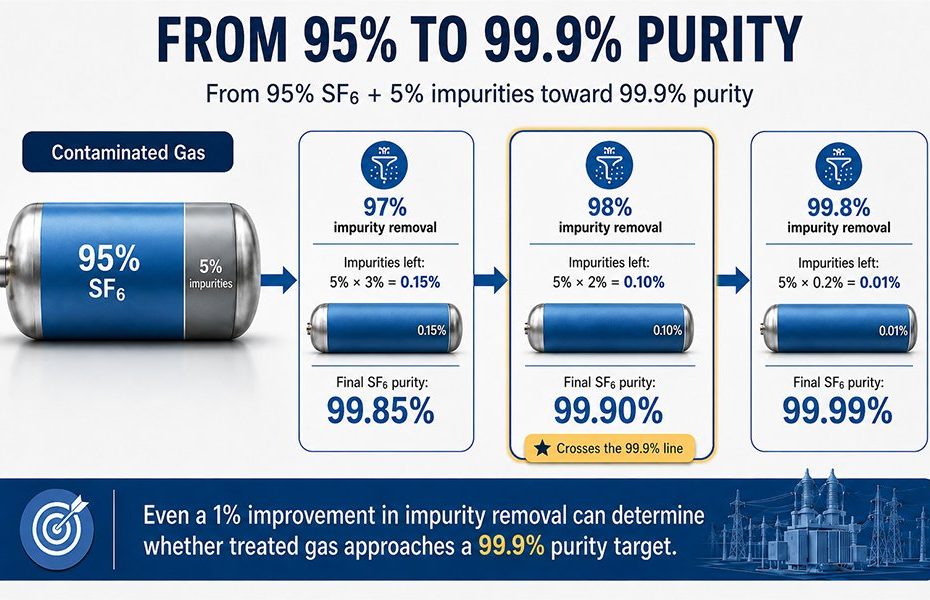
SF6 gas recovery removes gas from sf6 service equipment and transfers it into sf6-containing storage, but recovery alone does not improve sf6 gas purity. Recovered SF6 may contain air, moisture, oil, particles, and decomposition by-products introduced during service or operation. Therefore, skilled personnel must come recovery first, and then purification when the recovered gas requires further treatment. This article uses a simple example to show how impurity removal can raise SF6 purity, why nuances can have practical consequences in on-site operations, and how recovery and purification equipment help determine whether the treated SF6 gas is suitable for reuse.
Why Does Recovered SF6 Need Further Treatment?
In the T&D industry, GIS and circuit-breaker maintenance can suck contaminants into the SF6 service system through pipelines, seals, hoses, or gas-handling operation. Electrical arcing may also produce decomposition by-products. As a result, recovered SF6 may no longer meet the gas-quality requirements for sf6 gas reuse.
This has direct operational consequences. If the recovered gas contains too much moisture, decomposition by-products, air, or other contaminants, technicians may need to purify it before refilling. Therefore, recovered SF6 should not be considered ready for reuse until its quality has been qualified.
How Can 95% SF6 Become About 99.9% Purity?
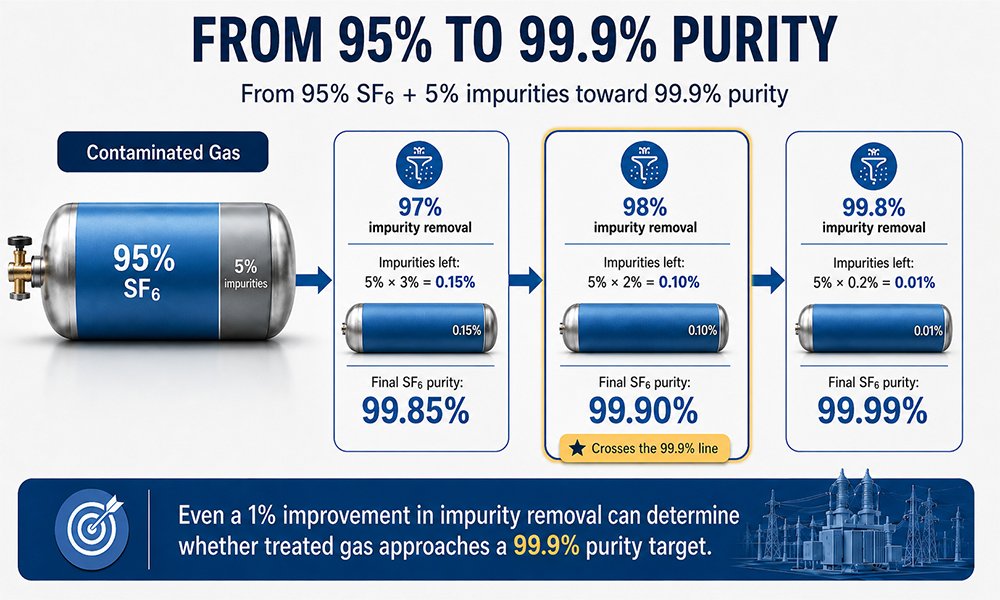
Consider a cylinder containing 95% SF6 and 5% impurities. Assume the purification process removes impurities without losing SF6. The mass-balance relationship is:
Final purity = SF₆ share + impurity share × (1 − η), where η is the impurity removal efficiency
If the initial batch contains 95 units of SF6 and 5 units of impurities:
| Impurity Removal Efficiency (η) | Impurities Remaining | Final SF6 Purity |
|---|---|---|
| 97% | 5% × 3% = 0.15% | 99.85% |
| 98% | 5% × 2% = 0.10% | 99.90% |
| 99.8% | 5% × 0.2% = 0.01% | 99.99% |
The calculation shows why even a tiny amount of residual contamination matters. Removing from 97% to 98% may appear to be only a minor improvement, but reaching each additional decimal place in purity requires more effective filtration, separation, and purification. In practice, this nuance can determine whether treated gas approaches the 99.9% purity level specified in GB/T 12022-2014 for pure industrial SF₆ gas.
However, purity improvement is not determined by impurity removal efficiency alone. Recovered gas can contain several contaminants, and purification may also involve small SF6 losses. Starting composition, treatment conditions, sampling quality, and equipment performance all affect the final result.
The Right Approach to SF6 Recovery and Purification
Effective SF6 gas management follows:
Recovery → Filtration → Purification → Gas Analysis → Reuse
For this stage, the RF-300J SF6 gas recovery and regeneration system combines gas recovery with filtration, purification, and recirculating treatment. Furthermore, technicians must analyze the treated SF6. The RF912 SF6 gas analyzer supports this step by measuring treatment parameters such as SF6 purity, moisture, and decomposition products.
Together, they help maintenance teams determine whether the gas can reuse to service, requires further purification etc.
If your project requires SF6 gas analysis, leak detection, recovery, purification, or lifecycle management, feel free to contact us at [email protected]. We would develop a practical SF6 gas-handling solution tailored to your project.
FAQ
Who we are?
We are a professional manufacturer of SF6 gas handling, detection, and monitoring solutions for the T&D industry. Our products cover SF6 recovery, purification, gas analysis, leak detection, online monitoring, and lifecycle management, supporting utilities, GIS manufacturers, and maintenance teams worldwide. With 30 years of expertise and practical experience in SF6 technologies and field applications, we focus on practical, reliable solutions tailored to real field requirements.
Is SF6 purity alone enough to determine whether the gas can be reused?
No. Purity is important, but it does not provide a complete picture of gas condition. Moisture, decomposition by-products, air, and other contaminants may also affect suitability for reuse.
Why does recovered SF6 sometimes require several purification cycles?
A single pass may not remove enough contamination from heavily degraded gas. Repeated circulation allows filtration, adsorption, and separation stages to reduce contaminants further and improve overall gas quality.
Why is gas analysis necessary after purification?
Purification improves gas condition, but it does not confirm the final result by itself. Gas analysis provides measured data on parameters such as SF6 purity, moisture, and decomposition products, allowing technicians to decide whether further treatment is necessary.