


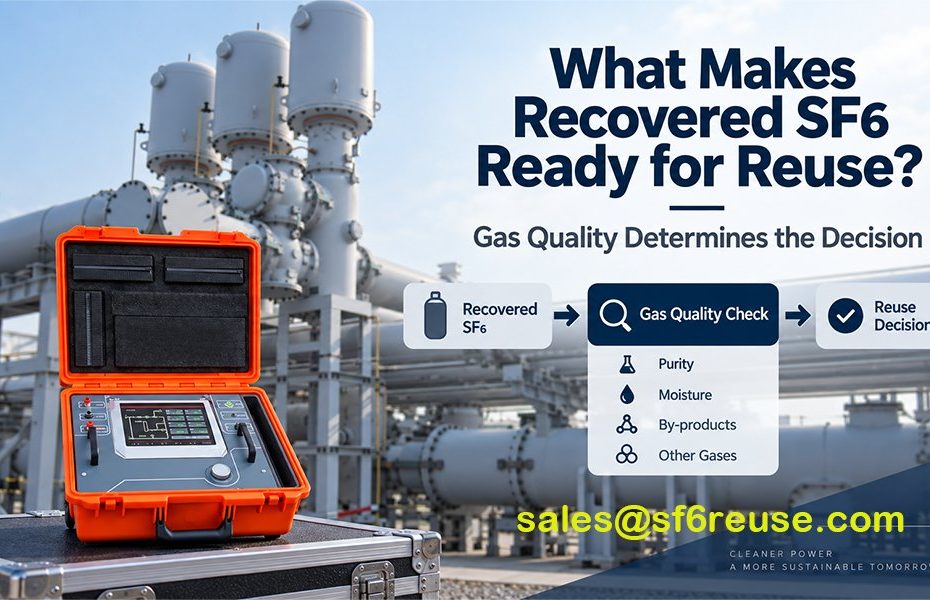
Recovered SF6 is not automatically reusable. Learn how gas quality, contamination, treatment, and retesting determine its reuse eligibility.
Recovered SF6 can only be reused after its gas quality has been verified and confirmed to meet the requirements of the intended application.
The reuse eligibility of recovered SF6 depends on several factors, including SF6 purity, moisture, decomposition by-products, air or other gas contamination, intended use, and applicable gas-quality requirements. Gas source and service history also help determine how the gas should be evaluated.
What Does “Ready for SF6 Reuse” Actually Mean?
“Recovered” simply means that the gas has been removed from equipment. “Ready for reuse” means much more. The gas quality must be verified, contamination must remain within acceptable limits, the gas must be suitable for the intended equipment, and the required checks must be completed. A simple way to express this is: Recovered SF6 + Verified Gas Quality + Suitable Application = Candidate for Reuse
The key word is candidate. A recovered gas batch is not automatically reusable. Final reuse eligibility still depends on the equipment and the applicable gas-quality requirements.
The Source of Recovered SF6 Affects the Reuse Decision
Recovered SF6 from different sources may require very different evaluation methods.
Routine Maintenance Usually Provides a Lower-Risk Gas Source
SF6 recovered during routine GIS maintenance or planned gas handling usually presents a lower risk when there is no known equipment fault or abnormal operating condition. However, the gas still needs to be tested before reuse.
Gas Recovered After an Internal Fault Requires Closer Evaluation
If the equipment has experienced arcing, abnormal discharge, or an internal fault, decomposition by-products require particular attention.
Unknown Gas History Increases Reuse Uncertainty
If the storage history is unclear, the cylinder cannot be clearly identified, or several gas batches may have been mixed, the gas should not be judged by appearance or pressure alone. The gas history helps determine what needs to be tested, but history alone cannot confirm gas-reuse eligibility.
Several Gas Quality Parameters Determine Reuse Eligibility
SF6 Purity — How Much Target Gas Remains
Purity indicates how much SF6 remains in the gas mixture. Common causes of lower purity include air ingress, N2 contamination, gas mixing, and previous gas handling. Most importantly, lower purity does not automatically mean that the gas must be discarded. However, it may prevent direct reuse.
Moisture / Dew Point — Prevent Direct Reuse Even When Purity Is Acceptable
Moisture matters for three main reasons. It can affect insulation performance, contribute to corrosion, and interact with decomposition by-products. The moisture result should therefore be assessed against the intended use and applicable requirements, rather than treated as an isolated number.
Decomposition By-products — Reveal Gas Stress and Contamination
Key indicators may include SO2, H2S, and other gases associated with SF6 decomposition. These measurements do more than indicate whether the gas is contaminated. They also help show what the gas has experienced and whether further treatment may be required.
Air and Other Gas Contamination — Change Reuse Eligibility
O2, N2, CF4, and other gases may be present in recovered SF6. This leads to an important point:
High SF6 purity alone is not enough.
Two gas samples with similar SF6 purity may still have very different compositions and contamination levels.
Compare the Results with the Correct Requirements
Many discussions stop after measuring purity and moisture. For a real reuse decision, however, the test results must be compared with the right requirements. There are three main levels to consider.
Applicable Gas-Quality Standards — Provide the Gas-Quality Baseline
Standards such as IEC 60480 provide a basis for evaluating SF6 intended for further use. The purpose here is not to interpret every limit in the standard, but to establish a practical decision framework.
Equipment or OEM Requirements — Set Additional Gas-Quality Limits
Specific equipment may have its own filling requirements, gas-quality limits, and maintenance specifications. These requirements may differ from, or be more restrictive than, general standards.
Intended Reuse Application — Determine Whether the Gas Is Suitable
The same batch of recovered SF6 may be suitable for one application but not another. The real question is not only: “Does this gas meet a standard?” It is also: “Does this gas meet the requirements of the equipment where it will be used next?” This is what turns gas analysis into a true SF6 reuse decision.
Classify the Recovered SF6
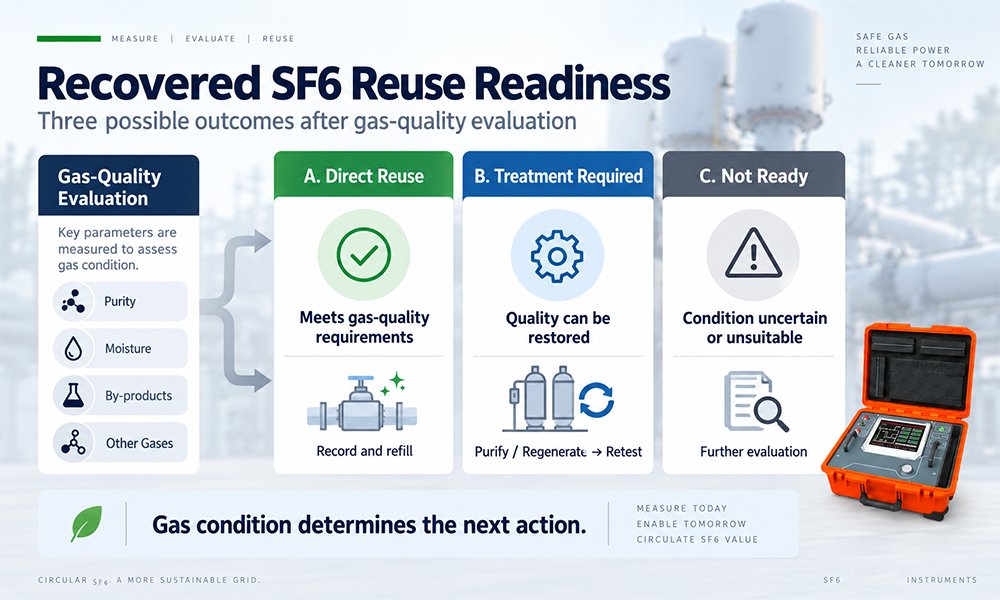
Recovered SF6 should be evaluated by gas quality before any reuse decision is made. Key parameters such as purity, moisture, decomposition by-products, and other gas contamination help classify the gas into three paths: direct reuse, treatment followed by retesting, or further evaluation. The gas condition—not the fact that it has been recovered—determines the next action.
Gas-Quality Decision Framework for Recovered SF6
The complete decision process can be reduced to five steps:
- Identify the gas source
- Take a representative sample
- Measure the key gas-quality parameters
- Compare the results with the applicable requirements
- Classify the gas
The decision then follows one of three paths:
⇒ Meets requirements → Direct reuse
⇒ Can be restored → Purification / Regeneration → Retest
⇒ Does not meet requirements and cannot be restored → Further controlled handling
One Test Result Cannot Confirm SF6 Reuse Eligibility
A good purity result does not prove that recovered SF6 is ready for reuse. A batch may have high SF6 purity but excessive moisture. Another batch may have acceptable moisture but elevated decomposition by-products. Reuse eligibility must be based on the overall gas condition, not one number.
Representative Sampling Is Essential for a Reliable Reuse Decision
Even a highly accurate analyzer cannot correct a poor or unrepresentative gas sample. Poor sampling can lead to misleading results and the wrong reuse decision. In field work, sampling lines should be properly prepared, ambient air ingress should be prevented, suitable sampling procedures should be followed, and the sample source should be recorded.
When Does Recovered SF6 Need Purification or Regeneration?
If the main problem is moisture, particles, or removable contamination, purification may be enough. If the gas is off-spec because of mixed gases or a more complex change in composition, regeneration or gas separation may be required. Treatment should match the gas condition. Recovery alone is not a reason to regenerate SF6.
Common Decision Errors Can Lead to Incorrect SF6 Reuse
- Assuming recovered gas is automatically reusable
Recovery does not equal qualification. - Checking only SF6 purity
One parameter cannot represent overall gas quality. - Reusing gas immediately after purification or regeneration
Treated gas still requires verification. - Ignoring where the gas will be reused
The same gas quality may not be suitable for every application.
FAQs
Can SF6 Be Reused If Its Purity Is High?
Not necessarily. Even with high SF6 purity, moisture, decomposition by-products, or other gas contamination may still affect reuse eligibility.
Is SF6 Purity Alone Enough to Determine Reuse Eligibility?
No. A reuse decision should consider purity, moisture, decomposition by-products, other contaminants, and the requirements of the intended application.
Does Recovered SF6 Always Need Purification?
No. If the gas already meets the applicable gas-quality requirements and is suitable for the intended equipment, it may be reused directly. Treatment is only required when the gas needs to be restored.
Why Must SF6 Be Retested After Regeneration?
Regeneration changes the condition of the gas. Its reuse eligibility must therefore be confirmed by measurement rather than assumed from the treatment process.
Who Decides Whether Recovered SF6 Is Suitable for Reuse?
The decision should be based on applicable standards, equipment or OEM requirements, the intended use, and gas analysis results. It should not rely on a single fixed value.
For more information about SF6 reuse and regeneration contact us at [email protected]
Pingback: How to Identify SF6 Gas Quality Problems Before SF6 Reuse - SF6 Reuse