


Quick Answer
Recovered SF6 may fail a gas quality test because of excessive moisture, low SF6 concentration, decomposition products, أو غيرها من الملوثات. لكن, an unexpected result may also reflect a sampling or measurement problem. Before choosing a treatment process, identify the failed parameter, confirm the measurement, and investigate the likely cause. Some problems can be corrected through drying or purification, while others require gas separation or further analysis. Reuse is justified only when the final gas batch meets all applicable quality requirements.
Identify the Failed Parameter and Apply the Correct Criteria
A failed SF6 gas quality test means that one or more measured properties fall outside the applicable acceptance criteria. It does not necessarily mean that the recovered gas must be discarded. The first task is to examine the individual measurements rather than the instrument’s overall pass/fail indication. For recovered SF6, the main parameters generally include SF6 concentration, moisture content, and selected decomposition products. Other contaminants, such as oil and solid particles, may also require assessment depending on the equipment and recovery conditions. Each measurement provides different information about gas condition: acceptable SF6 concentration does not guarantee low moisture or decomposition-product levels, while a satisfactory moisture reading cannot compensate for excessive unwanted gases.
The results must also be evaluated against the correct requirements. اللجنة الانتخابية المستقلة 60480:2019 provides specifications for the reuse of recovered SF6 and specified SF6 gas mixtures in electrical equipment, while IEC 60376:2018 addresses technical-grade SF6 and complementary gases. اللجنة الانتخابية المستقلة 62271-4:2022 covers gas-handling procedures rather than serving as a substitute for reuse-quality specifications. These distinctions become particularly important when evaluating SF6/N2 or SF6/CF4 mixtures, whose specified compositions differ from nominally pure SF6. Before investigating contamination, engineers should confirm which acceptance limits apply, whether the instrument is suitable for the gas composition, and which measurements actually exceed the requirements.
Verify the Measurement Before Treating the Gas
An unexpected gas quality result should be verified before the recovered batch is sent for treatment. Moisture measurements are particularly sensitive to sampling conditions because water retained in hoses, pressure regulators, or connectors can affect the reading. Insufficient preparation or stabilization of the sampling system may also produce a result that does not represent the actual gas condition. When moisture is unexpectedly high, engineers should check that the sampling connections are clean and dry, confirm that the instrument is operating within its specified conditions, and allow sufficient time for a stable reading. A repeat measurement using an appropriately prepared sampling arrangement can help distinguish genuine moisture contamination from a sampling problem.
Measurement units and instrument limitations require similar attention. Moisture may be reported as dew point, frost point, or parts per million by volume (ppmv), and dew-point values referenced to different gas pressures cannot be compared directly without appropriate conversion. SF6 concentration measurements can also be affected by the analytical method. Some instruments are calibrated for particular gas compositions, and their readings may be unreliable when the actual mixture differs significantly from those assumptions. A low concentration reading should therefore be interpreted alongside the instrument’s stated measurement capabilities, especially when nitrogen, CF4, or other gases may be present.
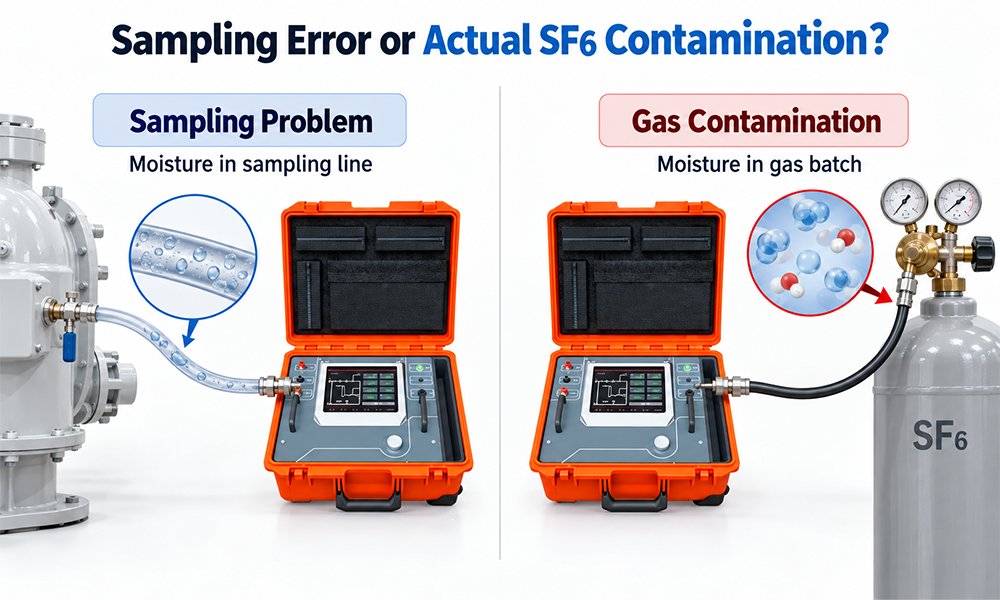
The sampling location can introduce additional uncertainty. In storage vessels containing both liquid and gaseous SF6, some contaminants may be distributed differently between the two phases. A sample taken from the vapor space may not always represent the composition of the entire stored batch. Engineers should therefore consider the vessel condition, sampling point, and analytical method when evaluating an unexpected result. If measurements remain inconsistent or uncertain, additional sampling or an independent analytical method may be necessary. Once the result has been confirmed against the applicable limit, attention can shift from measurement validity to the source and nature of the contamination.
Understand What the Failed Parameter Reveals
الرطوبة المفرطة may originate from inadequately dried gas-handling equipment, contaminated transfer hoses, insufficient evacuation, or residual water inside electrical equipment. Moisture can enter otherwise acceptable SF6 during recovery, transfer, or storage, making it important to review the conditions under which the batch was collected. If SF6 concentration and decomposition-product levels remain acceptable, moisture may be the principal problem, and treatment with a suitable drying system can often reduce the water content. لكن, drying recovered gas does not eliminate moisture remaining inside the receiving equipment. Where water contamination is suspected in the equipment itself, its condition must also be addressed before the gas is returned to service.
Low SF6 concentration may indicate air ingress, incomplete evacuation, or accidental mixing with another gas batch. Air can enter through leaking connections when parts of a recovery system operate below atmospheric pressure, while residual gases left in inadequately evacuated equipment can dilute the recovered SF6 during transfer. لكن, a concentration measurement alone does not necessarily identify the other gases present. A low reading cannot reliably distinguish unwanted air contamination from an incorrect SF6/N2 or SF6/CF4 mixing ratio. For intentional gas mixtures, the measured composition must be compared with the specified ratio rather than the requirements for pure SF6. Where unwanted dilution is confirmed, additional composition analysis may be needed to determine whether gas separation or regeneration is technically appropriate.
Decomposition products require a different assessment because they may reflect chemical changes caused by electrical discharges, switching operations, or faults within gas-insulated equipment. Sulfur dioxide (SO2) is commonly measured during field gas analysis, while other compounds, including sulfur oxyfluorides and hydrogen fluoride (HF), may also be relevant depending on operating conditions. An elevated SO2 reading warrants further investigation, particularly when the gas was recovered after an electrical fault. Nevertheless, SO2 represents only one possible decomposition product, and its concentration does not establish the total amount of acidic or potentially harmful contaminants. Where significant decomposition is suspected, additional analysis may be required to determine which compounds are present, what handling precautions are necessary, and whether the available treatment equipment can remove them.
Oil and solid particles may also affect recovered gas quality but are not necessarily detected by instruments measuring only SF6 concentration, الرطوبة, and SO2. Oil contamination can originate from gas-handling components or contact with lubricants, while solid particles may be introduced during equipment operation or maintenance. These contaminants require appropriate sampling, تحليل, and removal methods. When suspected contamination falls outside the analyzer’s measurement capability, the absence of an alarm should not be interpreted as evidence that the gas is clean. The diagnostic objective is to establish which contaminants are present and whether the available measurements are sufficient to support a treatment decision.
Select Treatment According to the Contamination
Once the failure has been confirmed, the treatment process should address the specific contaminant rather than the overall test result. Drying systems can reduce moisture, while suitable adsorbents and filters may remove selected decomposition products or particles. These processes cannot be assumed to correct substantial dilution by air, nitrogen, or CF4. If unwanted gases are present, an appropriately designed gas-separation or regeneration system may be required. Depending on the actual composition and system design, more extensive processing may involve cryogenic separation or rectification. The appropriate method depends on the identified contaminants, their concentrations, the treatment equipment’s capabilities, and the required final gas quality.
| Confirmed problem | Possible corrective approach | Main limitation |
|---|---|---|
| الرطوبة المفرطة | Drying with suitable desiccants | Does not correct low SF6 concentration |
| Unwanted air, ن2, or CF4 | Validated gas separation or regeneration | Conventional filters cannot provide effective bulk-gas separation |
| Decomposition products | Suitable adsorption, filtration, or further treatment | Removal depends on the compounds present |
| Oil or particles | Appropriate oil-removal and particle-filtration systems | Routine gas analyzers may not detect these contaminants |
| Multiple or unidentified contaminants | Additional analysis and combined treatment processes | One process may not address every contaminant |
For gas containing excessive moisture or selected removable decomposition products, on-site purification may be sufficient when the installed treatment media are suitable and have adequate capacity. More complex contamination may require regeneration or specialist reclamation, particularly when the gas composition must be corrected through separation. In either case, treatment effectiveness should be evaluated using measurements of the relevant parameters. If repeated processing produces little improvement, the contamination diagnosis, treatment-media condition, and equipment capabilities should be reassessed rather than continuing the same operation indefinitely. Gas with uncertain composition or contamination beyond the available equipment’s capabilities should remain segregated until suitable analysis or processing can be arranged.
Retest the Gas Before Approving Reuse
A completed treatment process does not automatically establish that the gas is suitable for reuse. Drying may substantially reduce moisture without bringing it below the applicable limit, while removing decomposition products may leave an unacceptable concentration of unwanted gases. The treated batch must therefore be evaluated against all relevant quality requirements, not only the parameter that originally failed. This assessment should include SF6 concentration, الرطوبة, decomposition products, and any additional contaminants identified during the investigation. Where routine field measurements cannot establish compliance, further laboratory analysis may be necessary.
Post-treatment sampling must also provide representative results. This is particularly important when the gas passes through multiple treatment stages or is transferred between storage vessels, where the risk of recontamination must be considered. Test records should identify the gas batch, sampling location, measurement units, instrument details, applicable acceptance limits, and relevant results before and after treatment. These records help engineers determine whether the selected process corrected the original problem and whether the complete batch meets the requirements for its intended application. A substantial improvement in one measurement is not equivalent to overall gas-quality compliance.
If the final results satisfy the applicable reuse requirements, the gas may be considered for return to service, subject to the equipment manufacturer’s specifications and relevant operating procedures. If one or more required parameters remain unacceptable, the batch should not be released for reuse. Further treatment, specialist reclamation, or another authorized management route may be necessary depending on the contamination and available processing options. A failed gas quality test is therefore a reason to investigate and correct a specific problem, not an automatic decision to discard the gas. The final reuse decision must be supported by verified measurements of the treated gas batch.
For more information with SF6 gas analysis, تقييم إعادة الاستخدام المباشر, أو تخطيط معالجة الغاز, اتصال [email protected]