


Quick Reading
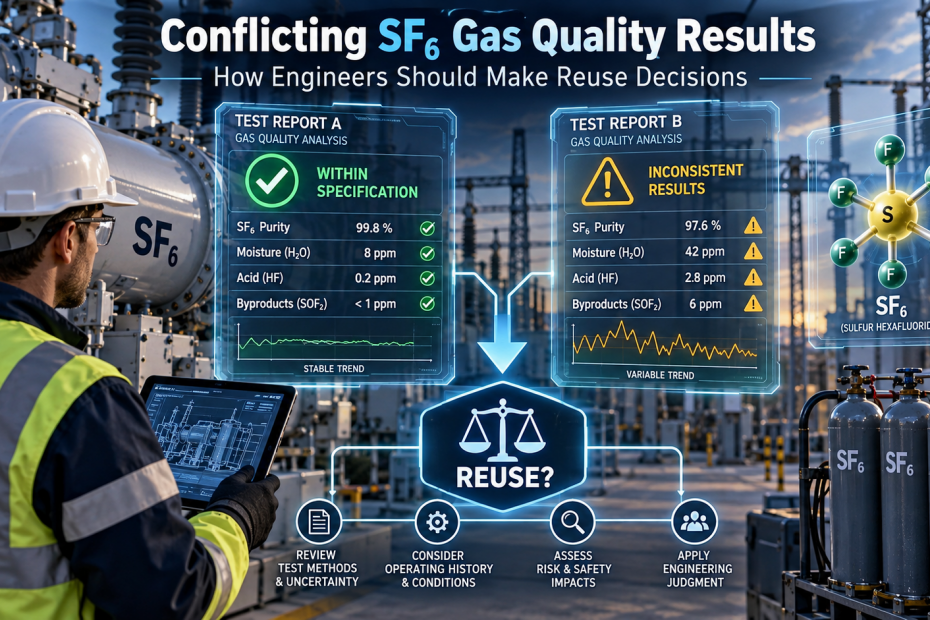
When SF₆ test results appear to disagree, do not average the values or rely on purity alone. Treat the result that indicates the greatest technical or safety concern as the limiting parameter, then confirm the measurement under controlled sampling conditions. High purity does not cancel excessive moisture or decomposition products. The final decision should consider the complete contamination pattern, the equipment application, applicable acceptance criteria, measurement reliability, and whether treatment has been proven effective.
Why SF₆ Quality Results Can Point in Different Directions
SF₆ gas quality is not defined by purity alone. A gas sample can contain a high percentage of SF₆ while still presenting problems related to moisture, Zersetzungsprodukte, Luft, oder andere Verunreinigungen.
Each test measures a different aspect of gas condition:
- Reinheit indicates the proportion of SF₆ in the gas mixture.
- Feuchtigkeit indicates the amount of water vapor present.
- Decomposition-product testing identifies chemically reactive or potentially corrosive by-products.
- Air or CF₄ measurements may identify dilution or contamination from other gases.
- Sampling information shows whether the result represents the gas in the equipment or only the gas captured during a particular sampling event.
These parameters do not substitute for one another. A passing purity result does not prove that the gas is dry. A low moisture result does not prove that decomposition products are absent. Similarly, a high by-product reading does not automatically mean that the entire gas volume has the same contamination level.
This is why apparently conflicting results are common. The tests may be describing different risks rather than contradicting one another.
A typical example
Suppose a recovered SF₆ sample shows:
- Purity within the applicable acceptance range
- Moisture above the relevant limit
- Elevated decomposition products
The correct interpretation is not that the gas is “mostly good.” The gas may have acceptable SF₆ concentration, but it is not yet suitable for unrestricted reuse if moisture or by-products exceed the applicable criteria.
The purity result answers one question: How much SF₆ is present?
It does not answer the separate questions:
- Is the gas sufficiently dry?
- Is it chemically clean?
- Can it be returned to service?
- Does it require filtration, Trocknen, Reinigung, or further investigation?

The Limiting Parameter Controls the Decision
For practical decision-making, the limiting parameter is the result that prevents the gas from meeting the required reuse condition.
This principle is important because gas quality requirements are generally not compensatory. A strong result in one category does not normally offset a failed result in another.
Zum Beispiel:
| Test result | What it tells you | What it does not prove |
|---|---|---|
| Acceptable SF₆ purity | The gas contains a suitable proportion of SF₆ | That the gas is dry or free from by-products |
| Acceptable moisture | Water vapor is within the tested criterion | That chemical decomposition products are absent |
| Low decomposition products | The tested by-products are within the relevant criterion | That purity and moisture are acceptable |
| Stable repeat result | The measurement is more likely to represent the sample condition | That the gas meets every reuse requirement |
The final classification should therefore be based on the worst applicable non-compliant parameter, provided the measurement itself is valid.
This does not mean that every abnormal reading requires immediate disposal. It means that the gas should not be classified as suitable for reuse until the abnormal result has been verified and addressed.
First Check Whether the Results Are Reliable
Before deciding that the gas condition is genuinely contradictory, check the measurement process. Apparent conflicts can result from sampling errors, instrument limitations, or different test conditions.
Confirm the sample source
A sample taken from a gas compartment may not represent gas in a recovery cylinder. Moisture and decomposition products can be distributed unevenly because of:
- Adsorption on internal surfaces
- Residual contamination in hoses or fittings
- Condensation or temperature changes
- Inadequate mixing after recovery
- Different gas phases or sampling locations
- Contamination introduced during connection or handling
Record where the sample was taken, when it was taken, and whether the gas had been mixed or allowed to stabilize.
Check sampling equipment
Sampling lines, regulators, filters, and connectors can influence results. Moisture-sensitive measurements are particularly vulnerable to wet hoses, poor purging, leaks, and exposure to ambient air.
Before repeating a measurement, verify that:
- The sampling line is suitable for SF₆ service.
- The line has been properly purged.
- Connections are leak-tight.
- The instrument is operating within its specified conditions.
- The sample flow is stable.
- The sample is not being exposed unnecessarily to humid ambient air.
A repeat test is useful only when the sampling conditions are controlled. Repeating the same flawed procedure may simply reproduce the same uncertainty.
Review the analyzer and method
Different analyzers may use different measurement principles, response times, detection limits, and correction methods. Results should not be compared as if every instrument has identical performance.
Review:
- Calibration status
- Measurement range
- Resolution and accuracy
- Gas temperature and pressure
- Required stabilization time
- Cross-sensitivity to other gases or by-products
- Whether the instrument is intended for the tested contaminant
- Whether the result is reported on a compatible basis
A result close to a limit deserves more scrutiny than a result far beyond it. When the decision has significant operational or environmental consequences, confirm the result using a calibrated instrument or an appropriate laboratory method.
Interpret Moisture and By-Products as Separate Risks
Moisture and decomposition products often receive attention together, but they provide different information.
Moisture is a physical and insulation-related concern
Excess moisture can affect insulation performance and may contribute to condensation risk under changing temperature conditions. The significance of a moisture result depends on factors such as:
- Equipment design
- Gas pressure and temperature
- Measurement location
- Whether the reading is reported as dew point, volume concentration, or another unit
- The applicable acceptance criterion
- Whether the gas is being assessed before or after treatment
A moisture reading should therefore be compared with the correct limit and measurement basis. Converting units without confirming the reference conditions can lead to an incorrect conclusion.
Decomposition products indicate chemical history
SF₆ can form decomposition products when exposed to electrical discharges, arcs, heat, Feuchtigkeit, or contaminated internal surfaces. Some by-products may be corrosive, toxic, or irritating. Their presence can also provide information about the condition of the electrical equipment from which the gas was recovered.
By-product results should be interpreted with attention to:
- Which compounds or compound groups were measured
- The detection method
- Whether the sample was taken before or after filtration
- The condition of internal adsorbents and surfaces
- The equipment fault or switching history
- Applicable handling and occupational safety procedures
Purification that removes moisture may not remove every decomposition product. Conversely, a filter designed for decomposition products may not provide sufficient drying. Treatment selection must match the identified contamination.
Separate “Suitable for Treatment” From “Suitable for Reuse”
This distinction is central to SF₆ gas management.
Gas can be suitable for treatment even when it is not suitable for immediate reuse. A recovery cylinder with elevated moisture or by-products may be a candidate for purification, Trocknen, oder Regeneration. Jedoch, that status does not mean the gas can be returned to electrical equipment without further processing and verification.
The decision path is usually more precise when divided into three classifications:
1. Suitable for direct reuse
This applies only when all required quality parameters meet the applicable criteria, the measurements are reliable, and the gas is compatible with the intended equipment and application.
2. Suitable for treatment and possible reuse
This applies when one or more parameters fail, but the contamination is understood and the available treatment process is designed to address it. Final reuse requires post-treatment testing.
3. Not currently suitable for reuse
This applies when contamination is severe, poorly characterized, unsafe to handle under the available controls, or not addressable by the available treatment system. Disposal or specialist processing may be necessary, subject to applicable regulations.
A purification or regeneration system does not guarantee compliance. Its effectiveness must be demonstrated through before-and-after measurements that address the original failure.
Use the Contamination Pattern to Guide Further Testing
Conflicting results should trigger diagnostic reasoning, not a single-parameter judgment.
Consider the pattern:
- High purity, high moisture: The gas may be mainly SF₆ but require drying or moisture control. Investigate sampling conditions and possible moisture ingress.
- High purity, high decomposition products: The gas may have been exposed to electrical discharge or contaminated internal surfaces. Assess by-product handling requirements and treatment capability.
- Low purity, acceptable moisture: The gas may be diluted by air or another gas. Investigate leaks, incomplete recovery, cylinder history, and analyzer suitability.
- Variable results between samples: Suspect stratification, inadequate mixing, sampling contamination, instrument instability, or a non-representative sample.
- All parameters near limits: Treat measurement uncertainty as important. Confirm calibration, repeat the test, and avoid classifying the gas solely on a borderline result.
The pattern also helps determine whether the issue is isolated to the recovered gas or may indicate a condition inside the electrical equipment. Elevated by-products, for example, may require equipment inspection in addition to gas treatment.
A Practical Decision Sequence for Engineers
When results point in different directions, use a documented decision sequence:
- List every measured parameter and its result.
- Record the test method, units, Probenahmestelle, Temperatur, pressure, and instrument identification.
- Compare each result with the criterion that actually applies to the intended use.
- Identify the limiting parameter.
- Assess whether the result is technically credible and representative.
- Repeat or confirm questionable measurements under controlled conditions.
- Classify the gas as direct reuse, treatment candidate, or not currently suitable for reuse.
- Select treatment only if it addresses the identified contamination.
- Perform post-treatment testing for every parameter that influenced the decision.
- Document the final release decision and supporting evidence.
This approach prevents a common error: accepting gas because one favorable result appears more familiar or easier to interpret than the others.
Do not average unlike results
Reinheit, Feuchtigkeit, and decomposition products are not interchangeable quality scores. They cannot be averaged into a single value that represents overall gas quality.
A gas with excellent purity and unacceptable moisture is not equivalent to gas with moderate purity and acceptable moisture. These conditions create different technical risks and require different responses.
What Evidence Supports Final SF₆ Reuse?
The final reuse decision should be based on verified compliance with the relevant requirements, not on the apparent success of a treatment process.
Useful evidence includes:
- Pre-treatment and post-treatment test results
- Stable repeat measurements
- Identified sampling locations and conditions
- Instrument calibration records
- Treatment equipment operating records
- Confirmation that the treatment system was suitable for the contamination
- Records of filters, adsorbents, or regeneration media where relevant
- Traceability of the gas cylinder or batch
- Confirmation that handling and storage conditions were controlled
Where a gas batch contains mixed sources or has been stored for an extended period, traceability becomes especially important. Combining gas from different compartments or cylinders can complicate interpretation and may spread contamination if the gas is not tested after mixing.
Relevant internal resources may include:
- [How to Test SF₆ Purity, Feuchtigkeit, and Decomposition Products]
- [SF₆ Gas Recovery and Storage: Preventing Cross-Contamination]
- [Can Contaminated SF₆ Gas Be Purified and Reused?]
- [How to Verify SF₆ Gas Treatment Effectiveness]
- [SF₆ Gas Handling Safety During Recovery and Maintenance]
The central engineering rule is straightforward: when SF₆ quality results appear to conflict, do not choose the most favorable result. Verify the measurements, identify the limiting parameter, and base reuse on the complete set of applicable requirements.