


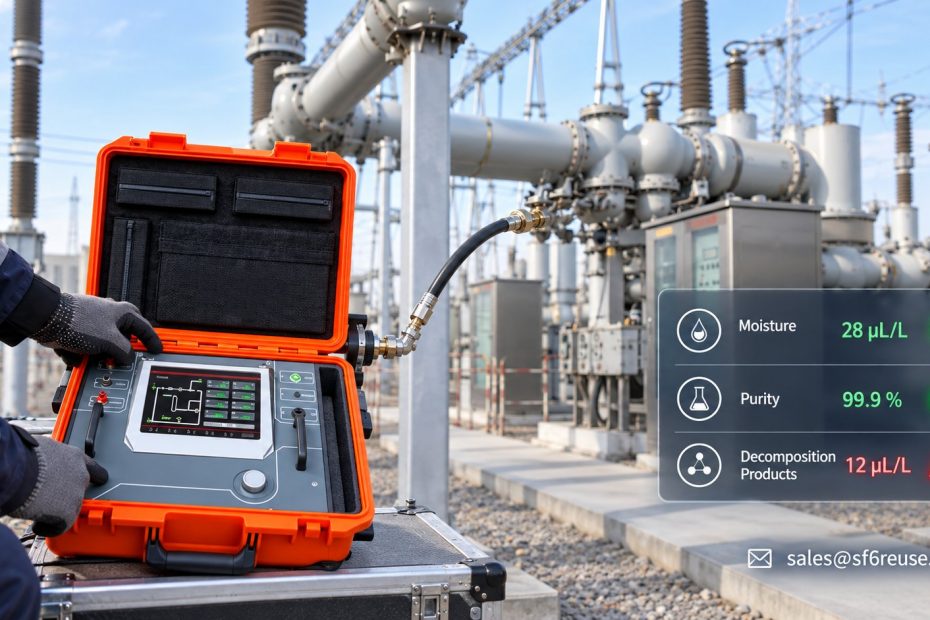
Learn how to diagnose moisture, low purity, productos de descomposición, contaminación por aceite, and mixture imbalance before SF6 reuse.
Respuesta rápida
When SF6 gas fails reuse requirements, the first step is to identify which gas quality parameters are out of specification. Excess moisture, low SF6 purity, productos de descomposición, and oil contamination may require different treatment methods. Engineers must also rule out sampling errors and confirm which acceptance limits apply. Once the actual problems are identified, they can select a suitable treatment process. The gas should only return to service after representative testing confirms that all applicable reuse requirements have been met.
SF6 Reuse Assessment Starts with the Applicable Gas Quality Requirements
A failed SF6 gas quality test does not necessarily mean the gas must undergo complete regeneration. It means that one or more measured parameters do not meet the requirements selected for that batch. Before recommending treatment, engineers must establish the applicable acceptance criteria and determine which results fall outside those limits.
CEI 60480 provides guidance and specifications for the reuse of SF6 and its mixtures in electrical equipment. National standards and equipment-specific requirements may also apply. These requirements are not always interchangeable. A gas batch may satisfy one set of limits while failing another, so the governing specification must be established before the test results are interpreted.
Gas composition also matters. Pure SF6 and SF6/N2 or SF6/CF4 mixtures must be assessed according to their intended applications. A lower SF6 concentration in a designed gas mixture is not automatically evidence of contamination. Conversely, a mixture that no longer meets its specified composition may require treatment even when other gas quality readings appear acceptable.
The purpose of this initial assessment is to distinguish parameters that meet the applicable limits from those preventing reuse. A parameter is only a reuse limitation when its measured condition violates a requirement that applies to the gas being evaluated.
Sampling and Measurement Errors Must Be Ruled Out Before Treatment
An out-of-specification reading should not immediately trigger gas treatment. Engineers first need to determine whether the measurement represents the actual condition of the batch.
Moisture analysis is particularly sensitive to sampling conditions. Residual water inside sampling lines, inadequate flushing, leaks, or insufficient stabilization time may affect the reading. A sample taken immediately after connecting a line may not represent the same gas condition as a properly stabilized sample. Instrument condition and measurement range also need attention, especially when results are close to the acceptance limit.
Gas composition introduces another source of uncertainty. Contaminants may not distribute equally between the gas and liquid
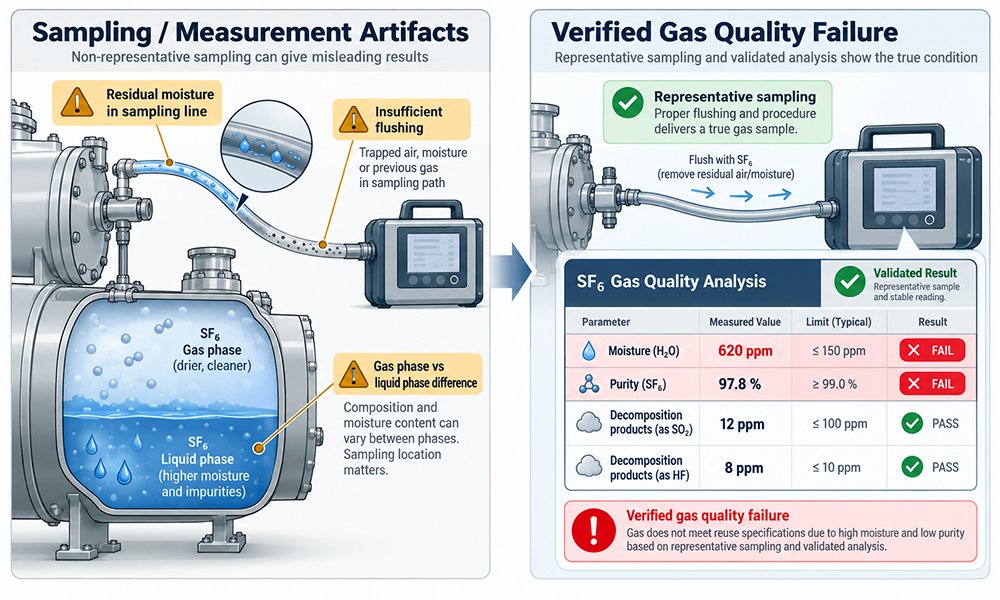
phases in a storage vessel. A sample taken from the gas phase may therefore differ from the overall composition of the stored batch. Sampling temperature, pressure, withdrawal method, and the vessel’s physical condition can all influence the result.
This distinction becomes important when a purity or composition reading appears inconsistent with previous measurements. Repeated testing under controlled conditions may reveal a sampling problem rather than a contamination problem. Sin embargo, repeatability alone does not guarantee that a sample represents the entire batch.
Before treatment begins, engineers should establish that the reported failure is supported by reliable, representative evidence. Otherwise, they risk selecting an unnecessary process or overlooking the actual cause of the failed reuse assessment.
The Failing Parameter Determines the Treatment Method
Once the measurements have been validated, the next decision is whether the identified contamination can be removed by the available treatment equipment. Different gas quality failures require different separation or purification mechanisms. No single treatment method should be assumed to address every possible reuse problem.
Excess moisture is commonly associated with residual water in equipment, gas-handling systems, or storage vessels. Suitable drying and adsorption processes can reduce moisture content, provided the treatment media and operating conditions are appropriate. Engineers must also consider whether residual moisture in the equipment or storage system could cause the gas to become wet again after treatment.
Low SF6 purity caused by air or CF4 contamination presents a different challenge. Conventional drying filters cannot selectively remove these gases simply because they can remove moisture. Depending on the composition and required purity, gas separation or rectification may be necessary. Treatment feasibility depends on the properties of the mixture and the capabilities of the selected system.
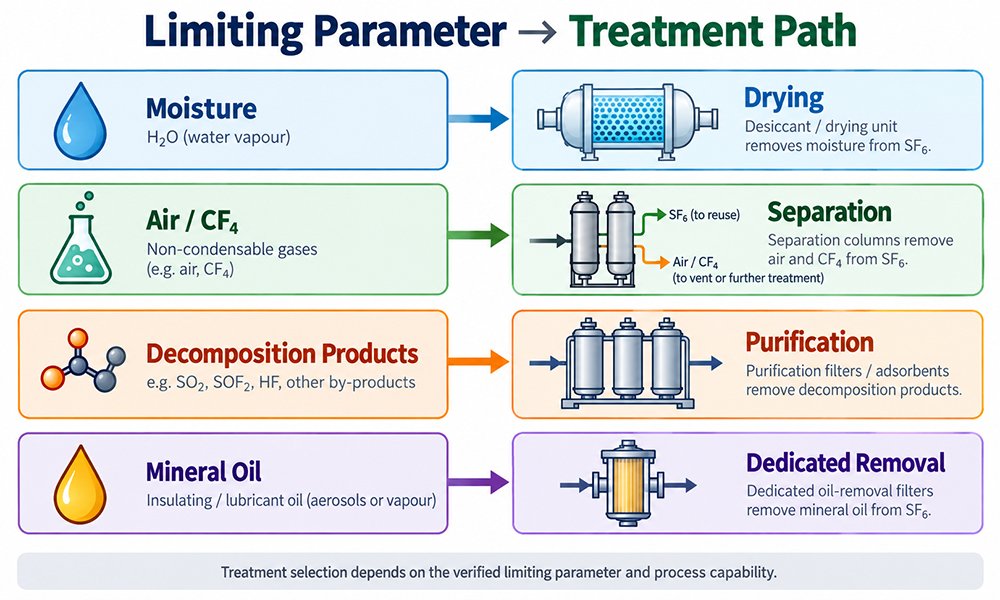
Productos de descomposición such as SO2 and other reactive compounds require purification methods suited to the substances detected. Appropriate adsorbents and filtration arrangements may reduce certain contaminants, but the effectiveness of the process depends on contaminant type, concentración, contact conditions, and media capacity. A reduction in one decomposition product does not establish that all relevant substances have been adequately removed.
Mineral oil contamination requires separate consideration. Oil may enter SF6 through gas-handling equipment and may appear as vapor, droplets, or deposits under different conditions. Dedicated separation or filtration measures may be necessary. The presence of oil contamination should not be treated as an ordinary moisture problem, and an adsorbent selected for drying should not automatically be assumed suitable for oil removal.
Mixed-gas batches require another assessment. For SF6/N2 and SF6/CF4 mixtures, engineers must determine whether the gas composition meets the requirements of its intended application. Depending on the mixture and available processing technology, an incorrect ratio may require controlled composition adjustment or specialized separation. These decisions cannot be made using pure SF6 purity criteria alone.
The following table summarizes the main treatment considerations.
| Verified gas quality problem | Treatment consideration |
|---|---|
| Excess moisture | Drying or suitable adsorption |
| Air or CF4 contamination | Gas separation or rectification |
| Productos de descomposición | Contaminant-specific purification |
| Mineral oil | Dedicated oil-removal measures |
| Incorrect mixed-gas composition | Mixture-specific treatment or separation |
These are possible treatment routes, not automatic solutions. A gas batch may contain several contaminants simultaneously, requiring more than one treatment stage. Engineers should assess the complete set of failed parameters before choosing a process, particularly when correcting one problem would leave another unresolved.
The decisive question is not simply whether a treatment system can improve gas quality. It is whether the system can address every verified limiting condition sufficiently to meet the applicable reuse requirements.
Treatment Results Must Be Verified Against All Reuse Requirements
A treatment process can operate as intended without producing gas that qualifies for reuse. A dryer may reduce moisture successfully while leaving excess air unchanged. A gas separation system may improve SF6 concentration without removing decomposition products to the required level. These outcomes demonstrate treatment progress, but they do not establish overall compliance.
Engineers therefore need to distinguish treatment effectiveness from final reuse eligibility.
Treatment effectiveness concerns whether the selected process has achieved its intended technical result. This can be assessed by comparing reliable measurements before and after treatment, under appropriate sampling conditions. Reuse eligibility requires a broader judgment: the treated gas must satisfy every applicable acceptance requirement, not merely the parameter targeted by the equipment.
Por ejemplo, an SF6 batch may initially fail both moisture and purity requirements. After drying, its moisture content may fall within the specified limit. That result confirms improvement in moisture control, but the batch remains unsuitable for release if the SF6 concentration still fails the governing specification. Additional treatment or another disposition decision is necessary.
Final verification should use representative samples and suitable instruments after the gas has reached an appropriate condition for testing. Engineers should review the full set of relevant results against the established acceptance criteria. When there is a significant difference between the results obtained before and after treatment, the sampling procedure and operating conditions should also be considered.
One passing measurement does not establish reuse eligibility when other required parameters remain unverified or out of specification. Gas should only be released for its intended application once the applicable acceptance requirements have been satisfied.
Some Gas Quality Problems Exceed On-Site Treatment Capabilities
Not every failed SF6 batch can be restored using the treatment equipment available at a substation or service location. The practical limits depend on the contamination profile, treatment technology, equipment capacity, and acceptance criteria.
Gas with excessive moisture may be suitable for on-site drying when an appropriately designed system is available. The same system may have no effective means of correcting significant air contamination or an incorrect SF6/CF4 ratio. Severe or combined contamination can also require a sequence of processes that an ordinary gas recovery unit was not designed to perform.
Repeated processing should not be used as a substitute for identifying the actual problem. If a system cannot remove the contaminant responsible for the failed assessment, additional treatment cycles may consume time without producing an acceptable result.
Another limitation arises when the sampling conditions do not provide sufficient confidence in the batch composition. In such cases, further analysis may be necessary before engineers can determine whether the gas is treatable through the available process.
When on-site equipment cannot address the verified limiting conditions, the batch may need to be transferred to a facility with suitable gas separation, purificación, or regeneration capabilities. The decision should consider both the technical feasibility of treatment and the ability to verify the final gas quality.
The practical objective is to make a defensible distinction between gas that already meets reuse requirements, gas that can be restored through an appropriate treatment process, and gas that cannot be qualified using the available equipment. Identifying the limiting parameters early helps prevent unnecessary processing and supports a more reliable decision about the next step toward SF6 reuse.