


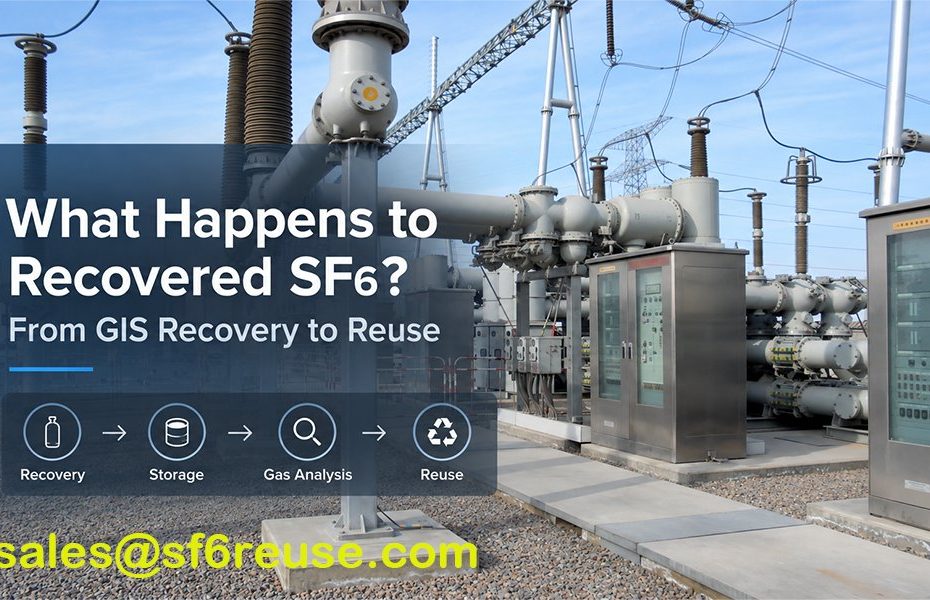
GIS メンテナンス後、回収された SF6 はどうなるか? SF6 のテスト方法を学ぶ, 浄化された, 再生された, 制御されたガスサイクルで再利用されます.
GISメンテナンス中, SF6 is normally recovered rather than released. しかし, recovered SF6 is not automatically ready for reuse.
After recovery, the gas is usually stored, analyzed, and classified. Its condition then determines the next step: direct reuse, 精製, regeneration, or controlled disposal.
In simple terms, the typical process is:
Recovery → Storage → Gas Analysis → Treatment Decision → Reuse
Where Does Recovered SF6 Go First?
From the GIS to a Storage Vessel
A recovery system removes SF6 from the GIS gas compartment and transfers it to a storage tank or gas cylinder. Depending on the system design, the sf6 gas may be compressed to increase storage density. This allows more SF6 to be stored safely in a limited vessel volume.
Why Is Recovered SF6 Stored Separately?
Recovered SF6 should not be mixed immediately with qualified gas because its condition is still unknown. Possible issues include: 過剰な湿気; Decomposition by-products; 空気の侵入; An uncertain service history This is why gas analysis must come before reuse.
Step 1: Recovered SF6 Must Be Tested Before Reuse
Before the gas is reused or further treated, several key parameters should be checked.
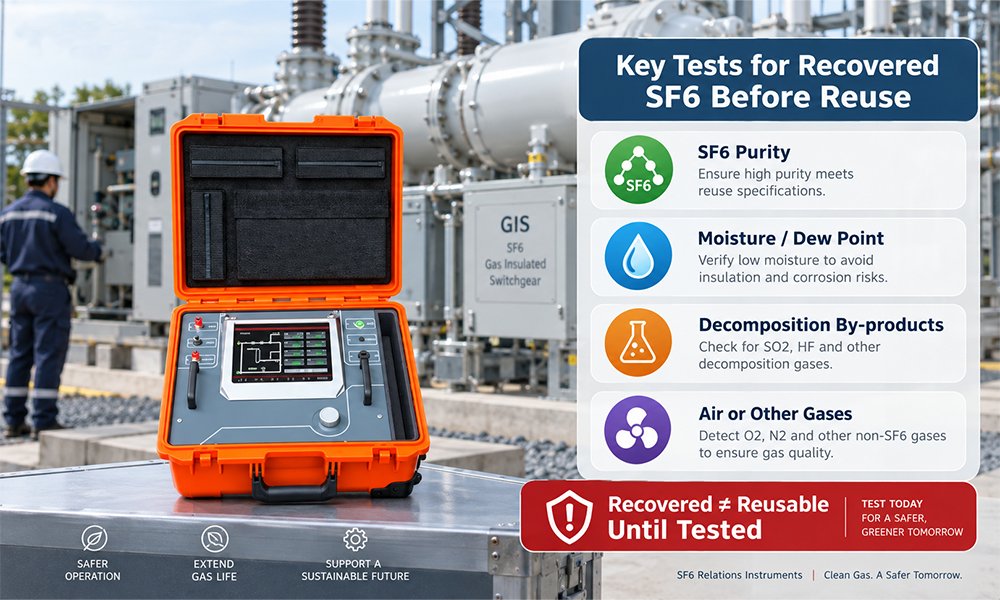
SF6 purity
Purity shows how much SF6 remains in the recovered gas and whether it meets the required gas-quality specification.
水分 / dew point
Excessive moisture can affect the insulating performance of the gas and the condition of high-voltage equipment.
Decomposition by-products
Gases such as SO2 and H2S can indicate SF6 decomposition and may also provide useful information about the condition of the equipment.
Air or other gas contamination
回収されたSF6には空気が含まれる可能性があります, N2, CF4, or other gases introduced during operation or maintenance.
Why Must Gas Analysis Come Before Reuse?
Two batches of SF6 recovered from similar GIS equipment may have very different gas quality. したがって: Recovered SF6 ≠ Reusable SF6
The correct sequence is: Recovery → Gas Analysis → Qualification → Reuse
Step 2: Classify the Recovered Gas and Decide What Happens Next
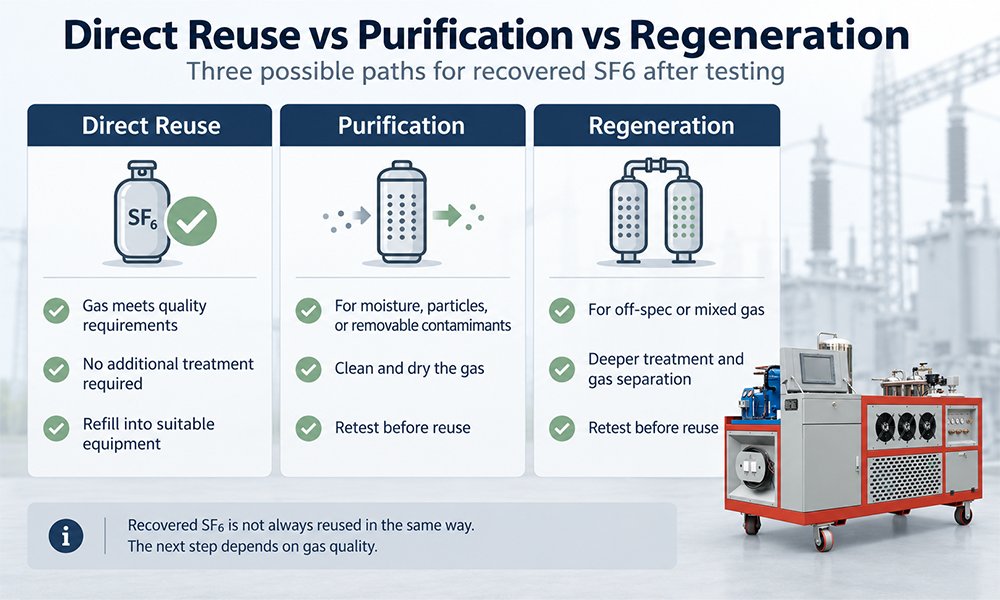
Based on the test results, recovered SF6 normally follows one of several routes:
- Meets the required gas-quality limits → Direct reuse
- Contains removable moisture or particulate contaminants → Purification
- Gas quality has deteriorated but can still be restored → Regeneration
- Cannot be safely or economically restored → Further controlled treatment or disposal
This classification is the key decision point between SF6 recovery and SF6 reuse.
Option 1: Qualified SF6 Can Be Reused Directly
Reuse in the Same GIS Equipment
One of the simplest closed-loop processes is: Maintenance → Recovery → Gas Analysis → Qualification → Refill
SF6 removed from a gas compartment during maintenance can be returned to the same equipment once gas analysis confirms that it meets the required quality limits.
Reuse in Other Suitable Equipment
Recovered SF6 may also be transferred to other suitable gas-filled equipment. Before doing so, consider: Gas quality; Equipment requirements; Contamination control; Traceability, including the gas source, test results, and destination
Recovery does not automatically turn SF6 into waste. If the gas still meets the required specifications, it retains its value for further use.
Option 2: Recovered SF6 May Need Purification
What Does SF6 Purification Remove?
Purification is mainly used to remove contaminants from recovered SF6, such as: 水分, 油汚れ, solid particles, some decomposition by-products
When Is Purification Enough?
Purification may be sufficient when the main SF6 composition remains acceptable but moisture or removable contaminants exceed the required limits. In this situation, the gas may not require more extensive regeneration.
Off-Spec SF6 May Require Regeneration
What Does SF6 Regeneration Do?
Regeneration goes beyond basic filtration and drying. Depending on the condition of the recovered gas, the process may include:
- Deeper contaminant removal
- Separation of air, N2, CF4, or other gases
- Restoration of SF6 purity
- Treatment of mixed or heavily contaminated SF6
Why Is Regeneration Important for SF6 Reuse?
Regeneration can extend the usable life of SF6 and create a closed-loop process: Recovery → Regeneration → Verification → Reuse
A field treatment record illustrates this process. In one case, SF6 purity increased from 89.04% に 99.93%. N2 content dropped from 9.06% に 0.05%, while CF4 fell from 1.00% に 0.02%. The treatment restored the gas to a condition suitable for further use.
What If Recovered SF6 Contains Air or Other Gases?
Air may enter gas-filled equipment during maintenance. In some applications, SF6 is also intentionally mixed with N2.
These gas mixtures cannot always be reused directly. They may require gas separation or more advanced treatment.
例えば, SF6/N2 mixtures can be treated using separation or low-temperature rectification processes. These processes recover the SF6 fraction while reducing unnecessary gas loss.
Can All Recovered SF6 Be Reused?
いいえ. Not all recovered SF6 is suitable for reuse. Gas-reuse eligibility depends on several factors:
- SF6 purity
- Moisture level
- Decomposition by-products
- Type and level of contamination
- Intended use
- Applicable gas-quality requirements, such as IEC 60480
Gas analysis is therefore essential before any reuse decision is made.
回復, Purification, Regeneration, and Reuse: What Is the Difference?
| Term | Meaning |
|---|---|
| SF6を回収 | SF6 removed from gas container and transferred to storage |
| Purified SF6 | Recovered gas that has undergone filtration, drying, or contaminant removal |
| Regenerated SF6 | Off-spec gas that has undergone deeper treatment to restore its quality |
| Reused SF6 | Qualified SF6 that is refilled into suitable electrical equipment |
These stages describe a typical SF6 lifecycle:
SF6 Recovery → SF6 Purification → SF6 Regeneration → SF6 Reuse
Not every batch needs every step. Gas quality determines the appropriate route.
よくある質問
Can recovered SF6 be put directly back into GIS?
Not automatically. Recovered SF6 should first undergo gas analysis to confirm its gas-reuse eligibility. Only qualified gas should be refilled.
Does recovered SF6 always need purification?
いいえ. If the gas already meets the required quality limits, it may be reused directly. Purification becomes necessary when moisture, 粒子, or other removable contaminants exceed acceptable levels.
How do I know whether recovered SF6 can be reused?
Use gas analysis to check SF6 purity, 湿気または露点, 分解副生成物, and contamination by air or other gases. Compare the results with the applicable reuse requirements.
What happens if the moisture level is too high?
The gas normally requires drying or purification before reuse. Its quality should then be tested again to confirm compliance.
Can contaminated SF6 be regenerated and reused?
In many cases, yes. Deeper purification and gas separation can restore contaminated or mixed SF6 to a quality suitable for further use.
From Recovery to Reuse: Keep SF6 in the Loop
Recovering SF6 from GIS is only the first step. The recovered gas should be stored, analyzed, and classified before its next use. Qualified SF6 can be reused directly, while off-spec gas may require purification or regeneration.
With the right handling process, much of the recovered SF6 can remain in a controlled reuse cycle rather than being treated immediately as waste.
For more information about SF6 reuse and regeneration contact us at [email protected]