


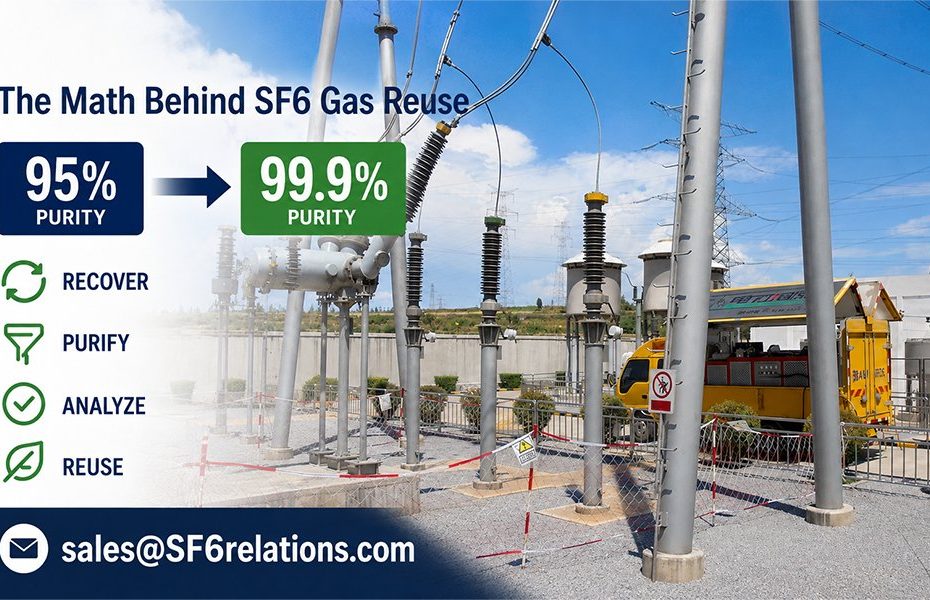
In the T&D-industrie, GIS and GIL maintenance often requires more than bringing a recovery unit to the substation. Technicians may need to recover SF6, evacuate the gas compartment, purify or recondition the recovered gas, verify its quality, and refill. A mobile SF6 maintenance truck addresses this challenge by carrying the main SF6 service equipment directly to the worksite. In China, this service model supports regional deployment and rapid response: when a maintenance need arises, the truck can travel to the site with the required equipment already onboard, allowing skilled personnel to begin work soon after arrival.
What Does a Mobile SF6 Maintenance Truck Do?
The SF6 service cart functions as a mobile gas-handling station. Its purpose is to keep the main stages of SF6 maintenance together and reduce the need to assemble several independent systems after reaching the substation.
Depending on the configuration, the onboard system can support:
Recovery → Storage → Vacuum Evacuation → Purification→ Gas Analysis → Refilling
During recovery, the SF6 service cart removes gas from sf6-filled equipment and transfers it into suitable storage. Treatment stages then use a molecular sieve desiccant to control particles, certain by-products, and water vapor. After treatment, gas analysis helps technicians determine whether the recovered SF6 is suitable for further use.
Because these functions operate within one coordinated platform, crews can establish leak-free connections and follow a defined gas-handling sequence instead of repeatedly moving equipment around the site.
How Do Mobile SF6 Maintenance Trucks Operate Efficiently in China?
Distance can become as important as equipment capacity during substation maintenance. Om deze reden, mobile SF6 service cart can be positioned in key regions with significant gas-handling and storage demand. When a utility or maintenance team requests service, the assigned vehicle travels directly to the substation with the principal equipment already installed.
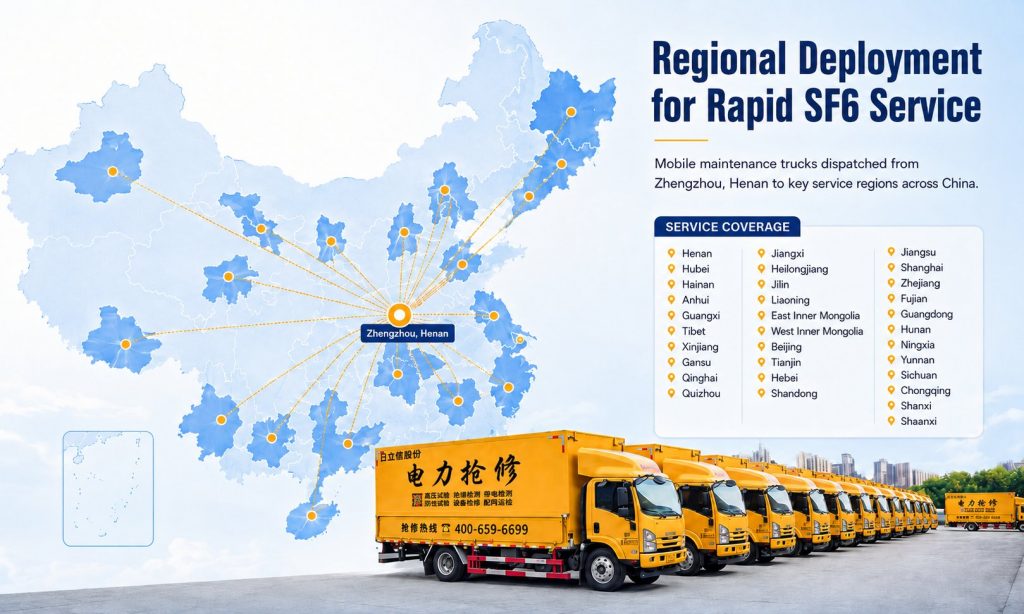
This regional model shortens preparation time. Technicians do not need to arrange separate transport for a recovery system, vacuum equipment, storage vessels, on-site filtration, and gas-analysis instruments for every project.
The truck therefore provides two capabilities at once: SF6 handling capacity and field mobility. This combination becomes especially useful for planned GIS maintenance, multi-compartment service, commissioning, and other projects that involve several gas-handling operations.
How Can the Truck Support Urgent SF6 Maintenance?
Urgent maintenance requires a different mobilization strategy from routine service.
When site conditions and project planning allow, the mobile workstation can leave for the substation before the complete service team arrives. Additional skilled personnel can then travel separately and begin the required work once they reach the site.
This approach avoids tying the arrival of the service equipment to the travel schedule of the entire crew. More importantly, the truck arrives with the core SF6 handling functions already integrated, so technicians can move quickly from site preparation to recovery, behandeling, analyse, and refilling.
For suitable projects, advance vehicle positioning can support an accelerated service schedule of approximately two days. Actual completion time, however, depends on travel distance, site readiness, SF6 quantity, the condition of the gas-filled equipment, and the required maintenance scope.
Rapid response therefore comes from logistics plus technical integration, not simply from a higher recovery flow rate.
How Can Overseas Projects Apply the SF6 Service Cart?
For overseas GIS and GIL projects, the mobile sf6 service truck can be adapted through a complete SF6 gas handling system configured around local site conditions and operating requirements. The truck can integrate the functions required for the complete gas-handling process:
- SF6 recovery and controlled storage;
- vacuum evacuation;
- filtration and purification;
- gas reconditioning or regeneration;
- gas analysis and quality verification;
- refilling.
These functions can be integrated into a locally suitable truck, trailer, container, skid, or fixed service platform, depending on site access, project scale, and local technical requirements.
Keep SF6 within a closed-loop handling cycle from recovery and treatment through verification and return to service. For large GIS or GIL projects, this modular approach also offers greater flexibility. Engineers can adapt system capacity, storage configuration, connection interfaces, and treatment functions to the actual maintenance scope rather than designing the project around a predetermined vehicle platform.
For project-specific SF6 recovery, zuivering, or mobile service configurations, contact [email protected].