



Leer hoe u kunt beslissen of herstelde SF6 direct kan worden hergebruikt, welke omstandigheden van de gaskwaliteit het bijvullen kunnen belemmeren, en wanneer behandeling nog nodig is.
Recovered SF6 can be refilled directly only when its current gas quality already meets all relevant requirements for the equipment it will be refilled into. If the gas still needs drying, zuivering, gas separation, or regeneration, it may remain suitable for future reuse, but it is not ready for direct refill. This distinction is the basis of the decision.
Direct reuse: Recover → Analyze → Verify → Refill
Reuse after treatment: Recover → Analyze → Treat → Retest → Verify → Refill
The practical question is not whether the recovered SF6 can eventually be reused. It is whether the batch can skip treatment now.
Direct Reuse Means No Treatment Remains Necessary
A batch qualifies for direct reuse when the gas needs no treatment before refill. Bij veldwerk, that means the recovered SF6 already has acceptable purity, vocht, decomposition-related condition, and gas composition for the intended equipment. It must not require drying, zuivering, scheiding, or regeneration before it goes back into service.
A gas batch may be treatable because its quality can be restored. That does not make it directly reusable in its present condition. Direct reuse describes the condition of the gas now. Treatability describes what that gas may become after processing.
Current Gas Quality Determines Whether Treatment Can Be Skipped
When reviewing a recovered SF6 batch, the key question is whether any measured parameter still requires correction before refill. One failed criterion is enough to stop direct reuse.
Purity is usually one of the first checks. If SF6 content falls below the applicable requirement, the batch does not qualify for direct reuse. Air ingress, mixed gas, previous handling, or another change in composition may explain the result. The gas may still respond well to treatment, but the refill decision has already changed.
Moisture can stop direct reuse even when purity looks good. A recovered batch may contain a high percentage of SF6 but still require drying before it can return to the equipment. In that situation, good purity does not offset excessive moisture.
Decomposition-related contamination requires the same type of judgment. Gas recovered after arcing, abnormale afscheiding, or an internal fault needs closer attention than gas removed during routine maintenance. If the relevant indicators show that treatment or further evaluation is required, a good purity result does not justify direct refill.
Lucht, N2, CF4, or other gases can prevent direct refill if they exceed the applicable limits. Some mixtures are intentional and application-specific. Others result from leakage, onderhoud, or mixed batches. If the gas composition has to be corrected through separation or another treatment process, the batch is not ready for direct reuse.
Applicable standards such as IEC 60480 and the equipment manufacturer’s specifications should provide the acceptance basis. A generic value from an article should not replace the requirements of the actual GIS or switchgear being filled.
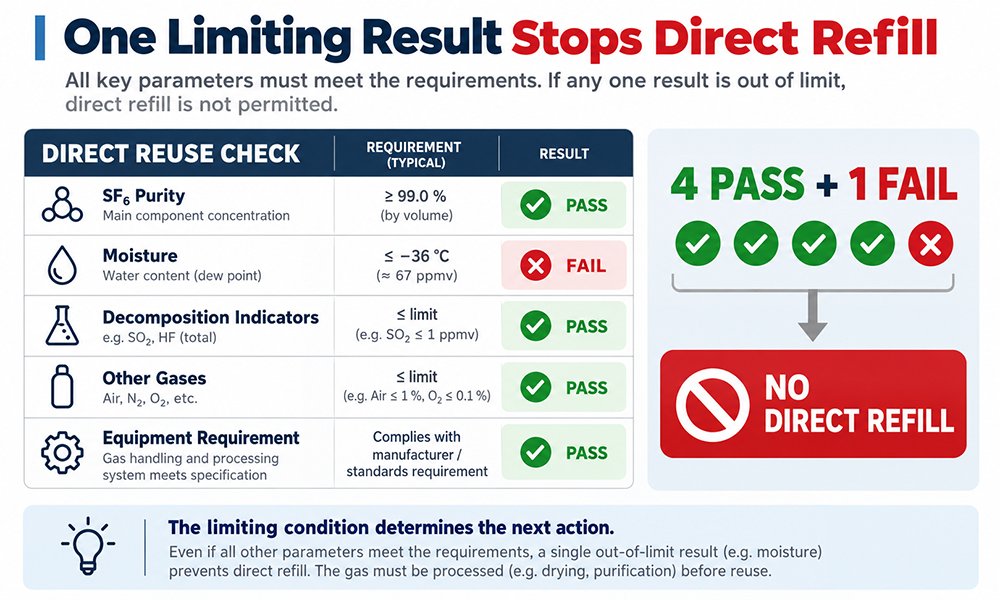
One Limiting Result Is Enough to Stop Direct Refill
All applicable criteria must be met at the same time. Suppose purity, decomposition-related indicators, and gas composition are acceptable, but moisture remains above the applicable limit. The batch is not “mostly suitable” for direct reuse. Moisture becomes the limiting condition, and the correct action is treatment followed by retesting. The same logic applies in the opposite direction. Excellent moisture results cannot compensate for unacceptable purity or excessive contamination by other gases. This is why I would not average good and bad test results into one general impression of gas quality. The limiting condition determines the next action. That principle makes direct-reuse decisions much clearer in the field.
High Purity Is Not Approval for Direct Reuse
A high SF6 purity result is useful, but it is only one part of the decision. A batch can still require treatment because of excessive moisture, decomposition-related contamination, or an unacceptable concentration of other gases. For example, good purity does not offset a moisture result above the applicable limit. The moisture condition still controls the next step. High purity supports a direct-reuse decision; it does not make the decision by itself.
The Target Equipment Defines the Acceptance Criteria
A gas batch cannot be approved in isolation. The test results must be checked against the requirements of the GIS or switchgear that will be refilled. OEM specifications, filling procedures, project requirements, and the specified gas composition may differ between applications. This is especially relevant for SF6 mixtures. A batch suitable for one application may therefore be unsuitable for another.
Treatable SF6 Follows a Different Route from Directly Reusable SF6
Both direct reuse and reuse after treatment can keep recovered SF6 in service. The difference lies in what must happen before refill. Direct reuse follows a short route: Recover → Analyze → Verify → Refill
The gas already meets the required condition, so additional treatment adds no value. A batch that needs treatment follows a longer route: Recover → Analyze → Treat → Retest → Verify → Refill
Here, the first analysis identifies a condition that blocks direct reuse. Treatment changes that condition, and retesting confirms whether the corrective step worked. The difference matters in practice. Direct reuse can reduce processing time and unnecessary gas handling. Treatment adds equipment, labor, and another verification step. That does not mean treatment should be avoided. It means treatment should be used when the gas condition requires it, rather than applied automatically to every recovered batch. A useful rule is: Treatability describes future reuse potential. Direct reuse describes current refill readiness.
A Batch Can Pass Some Checks and Still Fail Direct Reuse
Several common field situations show why a direct-reuse decision cannot rely on one favorable result. A batch may have excellent SF6 purity but excessive moisture. In that case, the gas may only need drying or purification, but direct refill should wait until treatment and retesting are complete.
Another batch may show acceptable purity and moisture after an internal fault, while decomposition-related indicators still raise concern. The equipment history and test results together justify further evaluation before refill.
A third batch may look acceptable on its main parameters but contain too much air or an unintended N₂ concentration for the target equipment. If the composition must be corrected, gas separation or another suitable treatment step comes first. These cases lead to the same engineering conclusion: One condition that requires correction is enough to close the direct-reuse route.
Reliable Measurement Supports the Approval Decision
A direct-reuse decision is only as reliable as the data behind it. Representative sampling matters. Ambient air entering a sampling line, residual contamination in hoses, or a poorly selected sample can produce a precise-looking result that does not represent the actual gas batch.
The analyzer must also measure the parameters required by the reuse procedure. For field work, this commonly includes SF6 purity, moisture or dew point, and relevant decomposition or contamination indicators.
A multi-parameter analyzer can make this evaluation more practical by checking several conditions from the same gas batch. Sample-gas recovery or pump-back can further reduce unnecessary SF6 loss during repeated measurements, while stored test records help maintain traceability.
The instrument provides evidence. It does not make the final engineering judgment.
Before approving direct refill, I would want the gas source identified, the sample to be representative, all relevant test results to meet the applicable requirements, and the target equipment to accept the measured gas condition. If drying, zuivering, scheiding, or regeneration is still required, direct reuse has not yet been justified.
Veelgestelde vragen
Can recovered SF6 be refilled immediately after recovery?
Only when reliable gas analysis confirms that the batch already meets all relevant requirements for its intended use. Recovery alone does not qualify the gas for refill.
Does high SF6 purity mean the gas can be reused directly?
Nee. Excessive moisture, decomposition-related contamination, other gases, or equipment-specific requirements can still prevent direct reuse.
Does every recovered SF6 batch need treatment?
Nee. If the gas already meets the applicable requirements, additional treatment may only add unnecessary handling. Treatment becomes necessary when one or more conditions need correction.
For support with SF6 gas analysis, direct-reuse evaluation, or gas treatment planning, contact [email protected].