


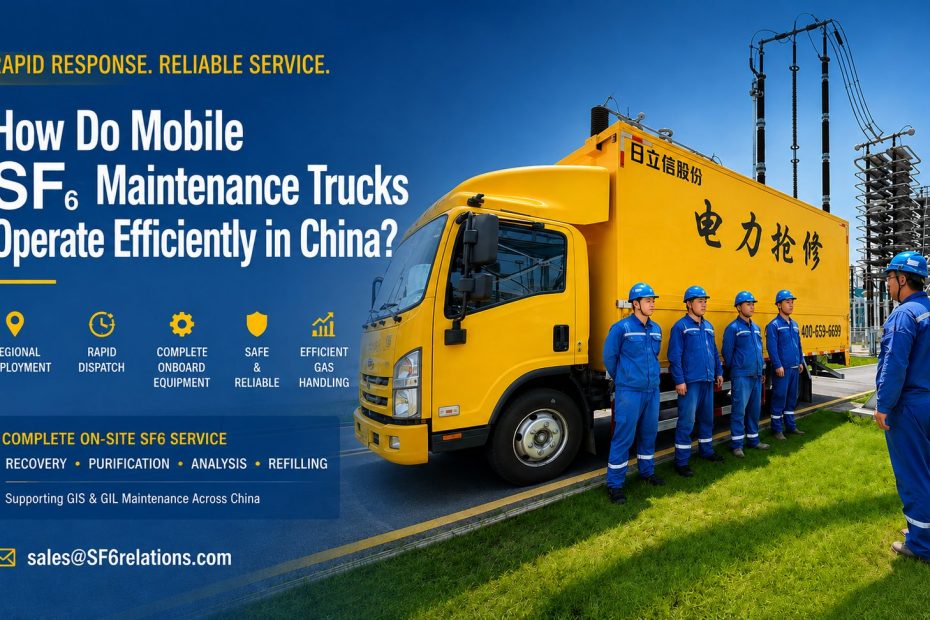
В Т&Д промышленность, SF6 handling can quickly become one of the most demanding parts of GIS and GIL maintenance. Recovery is only one step; technicians may also need vacuum evacuation, purification, storage, газовый анализ, and refilling. A mobile SF6 gas handling workstation brings these operation functions together at the worksite, which can simplify large-scale or multi-compartment projects and reduce repeated equipment changes. Yet this level of integration is not always necessary. Limited access, indoor installations, smaller gas volumes, or existing maintenance infrastructure may make standalone recovery and purification systems more practical. The right choice therefore depends on the complete operating workflow, site conditions, and required gas-handling functions.
Why Is On-Site SF6 Handling More Complex?
On-site SF6 handling involves much more than transferring sf6 gas out of GIS, ГИЛ, or other sf6 gas-filled equipment. During maintenance, technicians may need to recover the gas, evacuate the compartment, remove contaminants, verify gas quality, and refill the equipment before it returns to service. Each step depends on suitable SF6 service equipment and a well-planned operating sequence.
The challenge becomes greater when several independent units are used across the same worksite. A recovery system, vacuum equipment, storage vessels, on-site filtration, and gas analysis equipment may all require separate connections and repositioning. As the number of transfer points increases, technicians must pay closer attention to hose preparation, leak-tight connections, and gas cleanliness.
Gas condition also matters. Water vapor, частицы, and decomposition by-products may be present in recovered SF6, so recovery alone cannot determine whether the gas is suitable for reuse. Поэтому, field operations need to connect recovery, уход, verification, and refilling as a closed-loop cycle.
For large or repeated maintenance tasks, the real challenge is not performing each function individually. It is coordinating them efficiently while keeping the SF6 contained, traceable, and suitable for its intended use.
When Does a Vehicle-Mounted SF6 Workstation Make Sense?
A vehicle-mounted SF6 workstation is most useful when crews need to perform several gas-handling tasks repeatedly across the same substation. Instead of moving separate SF6 service equipment between GIS or GIL compartments, the team can bring the recovery system, vacuum equipment, storage, on-site filtration, газовый анализ, and refilling functions together on one mobile platform. Once the workstation is positioned, skilled personnel can establish leak-free connections and follow a defined operating sequence.
During recovery, SF6 moves from the sf6 gas-filled equipment into suitable storage through the required treatment stages. Depending on the system configuration, particle filtration can remove solid particles, an activated charcoal filter can help control certain contaminants and by-products, while a molecular sieve desiccant can reduce water vapor. Gas analysis then provides the information needed to evaluate the gas before further treatment or reuse.
This integrated arrangement is especially practical for large GIS or GIL projects, multi-compartment maintenance, commissioning, and repeated service work. More importantly, it connects recovery, уход, verification, and refilling within a closed-loop cycle, reducing unnecessary equipment changes and simplifying the overall SF6 handling workflow.
When Are Standalone SF6 Recovery and Purification Systems More Practical?
A vehicle-mounted workstation offers strong integration, but some maintenance environments require greater flexibility. Indoor GIS installations, restricted-access substations, smaller gas volumes, or sites with existing gas-handling infrastructure may favor standalone SF6 service equipment.
Instead of bringing every function onto one platform, operators can configure the system around the specific task. A recovery system can remove SF6 from gas-filled equipment, while separate vacuum equipment prepares the compartment for maintenance or refilling. Where treatment is required, on-site filtration or purification equipment can manage contaminants before gas analysis verifies the gas condition.
This modular arrangement also allows skilled personnel to position equipment closer to the work area and use only the functions required for each operation. Existing storage tanks, vacuum systems, or other site infrastructure can remain part of the workflow, avoiding unnecessary duplication.
Importantly, standalone does not mean disconnected. With suitable leak-free connections and a defined operating sequence, separate units can still support the same closed-loop cycle of recovery, уход, verification, and refilling.
The practical difference therefore lies in configuration: a mobile workstation prioritizes integration and mobility, whereas standalone systems prioritize flexibility and site-specific deployment.
How Should You Choose Between Mobile and Standalone SF6 Systems?
The right configuration depends on how the equipment will operate at the actual worksite. Rather than comparing systems by recovery capacity alone, operators should evaluate the complete SF6 handling workflow, including gas volume, site access, connection size, target recovery pressure, treatment requirements, and available infrastructure.
For large substations, multi-compartment GIS or GIL maintenance, and repeated service operations, a mobile SF6 gas handling workstation can simplify equipment deployment and keep recovery, purification, газовый анализ, vacuum evacuation, and refilling within one coordinated platform. This arrangement is particularly useful when crews need to move efficiently between several gas-filled compartments.
By contrast, standalone SF6 service equipment may provide greater flexibility for indoor GIS rooms, restricted-access sites, smaller gas volumes, or facilities that already have storage tanks, vacuum systems, and other supporting infrastructure. Operators can select only the recovery, on-site filtration, purification, or gas-analysis functions required for the task.
In either configuration, effective SF6 management depends on leak-free connections, appropriate gas treatment, reliable gas analysis, and a clearly defined closed-loop cycle. Skilled personnel should therefore select equipment around the operating conditions and required gas-handling functions rather than around a single performance figure.
Ultimately, mobile and standalone systems serve the same objective: keeping SF6 contained, traceable, properly treated, and suitable for its intended application. Choosing the configuration that best fits the worksite can improve operating efficiency while supporting more consistent SF6 recovery and reuse.
For assistance with selecting a mobile or standalone SF6 recovery and purification configuration, contact [email protected].