


Повторное использование SF6 – это больше, чем просто сбор загрязненного газа. В замкнутом цикле, Элегаз извлекается из газонаполненного оборудования., восстановленный, оценено на право на повторное использование газа, and returned to service whenever its quality meets the required criteria. This reduces the need for venting and can also limit the purchase of virgin SF6 gas.
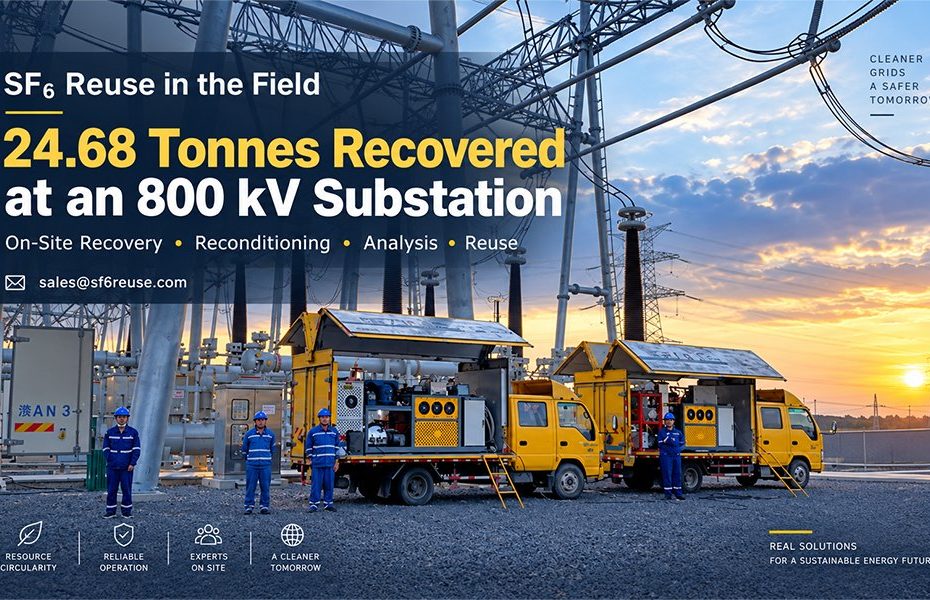
In May 2014, a field service team recovered 24,680 kg of SF6 during maintenance at the Pu’er 800 kV substation in Yunnan. One month earlier, another project at the Gezhouba 500 kV substation recovered 11,786 kg from switchgear. These projects show what SF₆ re-use looks like when it moves beyond policy and becomes part of day-to-day substation maintenance.
Why SF6 Reuse Became a Field Priority
The environmental case for recovery is straightforward. SF6 is a highly persistent greenhouse gas, so preventing avoidable releases can make a meaningful difference to a utility’s overall greenhouse-gas inventory.
Using the 23,900 global-warming-potential factor applied in the original project calculations, the service network recovered 246.3 tonnes of SF₆ during 2014. On that basis, keeping this gas within the recovery and reconditioning cycle instead of releasing it represented roughly 5.89 million tonnes of CO2-equivalent emissions avoided.
There was also an economic reason to recover rather than replace the gas. Based on the project estimates at the time, virgin SF6 gas cost about USD 10 per kilogram, while a 50 L cylinder was worth roughly USD 500. When a single substation contains several tonnes of SF6, recovery and reconditioning can reduce both gas losses and the cost of replenishment.
For large gas-filled equipment, SF6 reuse therefore becomes more than an environmental measure. It is a practical way to curb SF6 emissions, conserve the existing gas inventory.
How SF6 Reuse Works During On-Site Maintenance
At a live maintenance site, SF6 gas reuse follows a controlled closed-loop cycle. The mobile recovery system first removes SF6 from the gas-filled equipment at a recovery rate of up to 150 kg/h. Negative-pressure recovery then reduces the amount of residual gas left inside the compartment, allowing more of the existing SF6 inventory to remain within the recovery process.
The recovered gas then passes through on-site filtration and reconditioning to remove moisture, частицы, and other contaminants. Rather than assuming that treated gas is ready for reuse, technicians perform gas analysis to verify its condition. Only SF6 that satisfies the required gas-reuse eligibility criteria is returned to service.
Once the gas has been verified, it can be transferred back into the equipment or placed in suitable storage cylinders. A dedicated booster can fill a 40 L cylinder in approximately five minutes, helping the service team complete recovery, reconditioning, анализ, and refilling within a limited maintenance window.
The result is a practical field process:
Recover → Recondition → Analyze → Verify → Reuse
Instead of treating used SF6 as waste, the process keeps suitable gas within the closed-loop cycle and minimizes the amount lost during maintenance.
SF6 Reuse in Nuclear Power Maintenance: A Long-Term Field Application
Nuclear power maintenance places a high value on process control, gas quality, and reliable field execution. At Qinshan Nuclear Power, our service teams have provided annual engineering support since 2009, including work associated with expansion projects and major overhauls.
During an overhaul of 500 kV GIS, a mobile SF6 recovery and reconditioning system was used directly at the maintenance site. Instead of treating the recovered gas as waste, the team carried out recovery, on-site filtration and reconditioning, followed by gas analysis to determine its condition and gas-reuse eligibility.
The plant operator’s evaluation confirmed that the treated SF6 met the required quality criteria for reuse. The mobile system also allowed recovery and reconditioning to be completed on site, while maintaining stable and reliable operation throughout the service process.
This long-term application demonstrates an important principle of SF6 gas re-use: recovered gas should not be returned to gas-filled equipment simply because it has been processed. Its quality must first be verified. When the required criteria are met, the gas can remain within the closed-loop cycle rather than being unnecessarily replaced with virgin SF6.
For nuclear-power maintenance, that combination of controlled recovery, reconditioning, газовый анализ, and verified reuse provides a practical way to conserve the existing SF6 inventory while supporting reliable maintenance and servicing.
To plan a recovery-and-reuse program for your fleet, contact the engineering team at [email protected].