


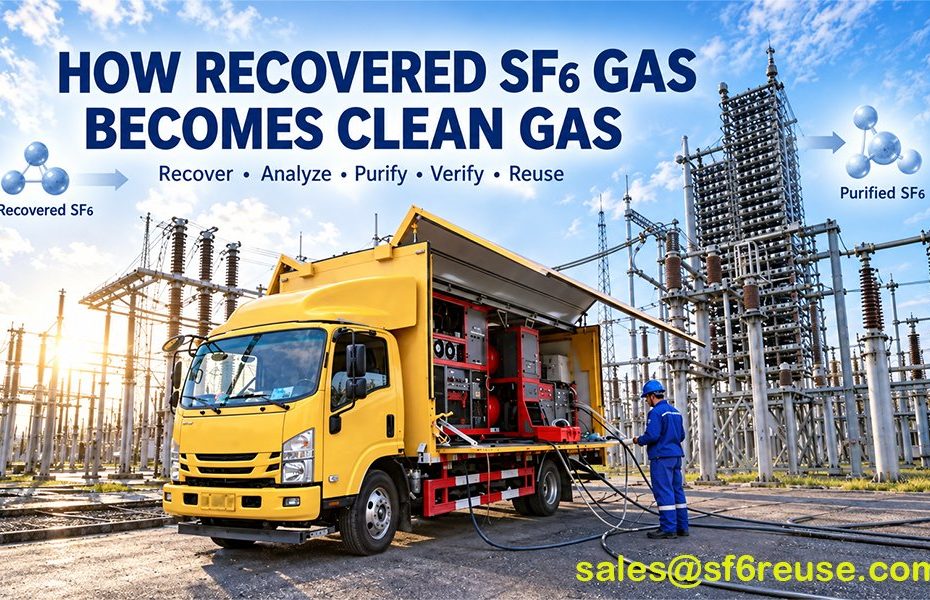
Un pensionato 66 L'interruttore kV mantiene approssimativamente 40 kg di gas SF6. Rilasciato nell'atmosfera, quella singola carica equivale a circa 940 tonnes of CO₂ — because SF6 gas has a global warming potential 23,500 times that of CO₂ (IPCC AR5). Yet the same 40 kg, recovered, purified and refilled, re-enters service as new gas and produces a quantified carbon credit. The difference between those two outcomes is not the gas. It is the process.
In China this is no longer theory. State Grid reported 3,200 tonnes of SF6 recovered cumulatively by the end of 2025 — about 80 million tonnes of CO₂ avoided — at a 97 % recovery rate.
What sf6 reuse actually means
Reuse is not storage, and it is not disposal. It is a closed cycle of four steps: recovery → sampling and analysis → conditional purification → refilling with certified gas.
The analysis step decides everything. Recovered SF₆ intended for reuse is assessed per IEC 60480:2019, with sampling and handling per IEC 62271-4:2022. Only after the numbers are known is treatment applied — and only where the numbers say it is needed: circulation through molecular-sieve filtration when moisture is out of limit, cryogenic separation when air or CF4 is.
Does it work? In commissioning of an RF-300J mobile regeneration device, gas that arrived at 89.04 % SF6 gas and 9.96 % N2 left at 99.93 % purity, with CF4 reduced from 0.9966 % A 0.0182 % — meeting the targets of purity ≥ 99.9 %, CF₄ ≤ 0.01 % and air ≤ 0.03 %.
Your data is worth money
Since the CCER methodology for SF6 recovery and purification was published, recovered kilograms no longer equal credits automatically. The rules are strict and specific: scales of accuracy Class III or better; flow meters within ±1.5 %; raw data fed into the project data system every second and uploaded to the national carbon-market platform every minute; every cylinder number and source-equipment ID recorded; gas from inside the project boundary never mixed with outside gas. Purified gas must meet GB/T 12022 before reuse. If metering falls out of calibration, readings are discounted conservatively.
The implication for equipment selection is direct: the audit trail is designed into the machine, or it does not exist. Tank weighing, metered interfaces, cylinder-level traceability — these are no longer conveniences; they are what makes a project auditable.
What this is worth
- To the finance department: virgin SF6 costs about USD 10/kg and every 50 L cylinder adds about USD 500 — before transport, loading and inventory. Regeneration removes those purchases and their handling chain.
- To operations: every kilogram purified on site stays on site — no cylinder logistics, no transport permits, no extra leakage points during handling.
- To ESG and compliance: each recovered kilogram is a documented, third-party-verifiable emission reduction under a national methodology.
The capability behind the cycle
Closing the loop takes equipment built for each leg of the journey: a recovery device with oil-free compression under negative pressure and molecular-sieve drying per DL/T 662; a regeneration unit that analyzes first and treats only what analysis demands; and metering points laid out exactly where the methodology’s boundary diagram places them — recovery inlet, before and after purification, cylinder by cylinder.
Planning an SF6 reuse program — on-site, centralized, or CCER-registered? Contatto [email protected] for the RF-300J specification sheet and a reuse-cycle consultation.